
With the Prime Minister’s recent announcement to develop Canada’s first National Water Security Strategy, on March 23rd, AquaAction convened a roundtable with federal leaders and number of water leaders, from philanthropy, academia, and science organizations. The following briefing brings together all the participants' views into one cohesive set of priorities to guide the Canada Water Agency.
.jpg?width=588&height=441&name=Media%20(1).jpg)
Why Canada Needs a Water Security Strategy Now
Canada is entering a new era in water. Climate extremes, population growth, aging infrastructure, depleting water sources, and cross-border pressures are converging faster than existing systems can respond. The past is no longer a guide to the future.
An important first step to a water security strategy is to create a clear and actionable definition of “water security” that is inclusive and equity based.
Participants underscored that water cannot be treated solely as an environmental issue, because it is increasingly a matter of:
-
Economic security, underpinning agriculture, energy, infrastructure, and industry.
-
Community well-being and equity, with ongoing access and quality challenges.
-
National sovereignty, in a context of growing global and continental water pressures
-
Reconciliation, and relationship building with Indigenous Peoples.
However, many barriers were raised in the successful management of freshwater in Canada, which included:
- Data gaps limit our ability to anticipate and manage risk
- Innovation struggles to scale domestically
- Public awareness of freshwater quantity, quality and vulnerabilities, and water in general remains low which hinders action
- Governance remains fragmented across jurisdictions and federal departments
There was strong alignment that water security presents a generational, nation-building opportunity, but that without a coordinated strategy, Canada risks falling behind both domestically and globally, in terms of our capacity to respond to water issues, and emerging market opportunities.
Strategic Priorities for a National Water Security Strategy
Priority 1: Strengthening Data Collection, Prediction, and Freshwater Research Infrastructure
Canada’s ability to manage water risk depends fundamentally on the strength of its data systems and predictive capacity. Freshwater data should be treated as critical security infrastructure, as it underpins everything from early risk detection, effective water management and long-term planning and governance.
Long-term datasets enable historical understanding and early warning of threats such as contamination, drought, and ecosystem shifts. However, these datasets are fragile and often under-supported. Groundwater data is insufficient to guide good governance. Once gaps occur, the loss of knowledge is permanent.
At the same time, Canada must move beyond reliance on short-term forecasting toward long-term prediction, which enables infrastructure planning, climate adaptation, and strategic decision-making. Predictive modelling must be grounded in field-based research to ensure that emerging tools, including AI, reflect real-world conditions.
Canada relies in part on the United States for critical data used to manage its natural resources, particularly in shared waters. The national security strategy presents an opportunity to clearly identify the data Canada requires to ensure sovereignty and strengthen its independent decision-making capacity.
Water systems operate at a continental scale. Canada must therefore invest in predictive systems that reflect this reality, including collaboration on a North American water modelling framework.
Priority 2: Advancing Inclusive Governance and Indigenous Leadership
Many participants emphasized that water security cannot be achieved without inclusive governance structures that enable shared decision-making and authority, particularly with Indigenous Nations.
A national strategy must involve Indigenous knowledge systems alongside western science, ensuring that policies and management approaches reflect both lived experience and scientific understanding. Indigenous Nations hold deep, place-based knowledge that strengthens predictive capacity and improves outcomes.
Effective governance also requires clear roles, accountability mechanisms and structures that translate knowledge into long-term action. Co-development and co-governance models were highlighted as essential, particularly when aligning federal, provincial, Indigenous, and philanthropic actors.
Priority 3: Aligning Investment, Philanthropy, and Public Financing
Water security represents a nation-building investment opportunity, and one that is uniquely positioned to align public and private capital.
Canadian philanthropy is mobilizing at an unprecedented scale, creating a rare opportunity for the Government of Canada to co-invest and amplify impact. However, this alignment requires a clear federal signal.
The BC Watershed Security Fund is a leading example. Backed by a $100 million provincial investment and co-developed with First Nations, it generates ongoing enduring funding (through an endowment base and flow through funding), leverages philanthropic contributions, and delivers tangible outcomes in communities.
A national security strategy can build on such models by catalysing co-investment between federal, philanthropic and private partners, particularly where philanthropy and other partners see significant senior government investments. The best outcomes could be achieved by providing durable multi-year funding commitments, wherein funding mechanisms are connected to, but not fully controlled by, government.
Signalling and delivering that alignment soon will drive investment while there are growing marketing opportunities.
Priority 4: Scaling Innovation, Technology, and Economic Opportunity
Water security must be positioned as a core economic priority.
Canada has significant potential to lead globally in water innovation, but structural barriers prevent scaling. Participants emphasized the need for a full value-chain approach, connecting research, piloting, commercialization, procurement, and scale-up.
Global demand for water tech solutions is rising rapidly due to climate impacts and contamination risks, creating both urgency and economic opportunity. However, without coordinated federal action, Canada risks losing intellectual property, talent, and long-term competitiveness.
The federal commitment to a $100M Water Security Technology Fund was identified as a critical opportunity to anchor a national innovation pipeline.
Priority 5: Adopting a Holistic Ecosystem Approach with Integrated Groundwater Management
Water security must be grounded in a holistic, ecosystem-based approach that recognizes the interconnected nature of surface water, groundwater, ecosystems, and human systems.
Groundwater is often overlooked despite being foundational to communities and the economy. Effective water security requires integrating groundwater and surface water governance, supported by shared data, inclusive institutions, and coordinated investment.
This approach also requires recognizing ecosystem health—water flows, biodiversity, and resilience—as core elements of economic and water security.
Priority 6: Raising Public Awareness and Advancing Water Literacy
Participants emphasized that water literacy is a prerequisite for action.
A majority of Canadians do not understand where water comes from, how much is available, or the risks facing freshwater systems. This lack of awareness limits political will, public support, and long-term investment.
Water literacy must therefore be a core component of the strategy, including public education, workforce development and the integration of water into broader policy mandates. Investing in water literacy is a long-term strategy that builds capacity across generations.
Concluding Priority: The Importance of Budget 2026
Canada has the foundations to build a world-leading water security system, but success will depend on clear priorities, coordinated action, and sustained investment.
Participants all agreed: a strong signal in Budget 2026 will be essential to advancing the National Water Security Strategy, demonstrating federal leadership that will help to unlock philanthropic and private capital.
This is a generational moment. Acting decisively now will determine whether Canada secures its water future or continues to manage it piecemeal.
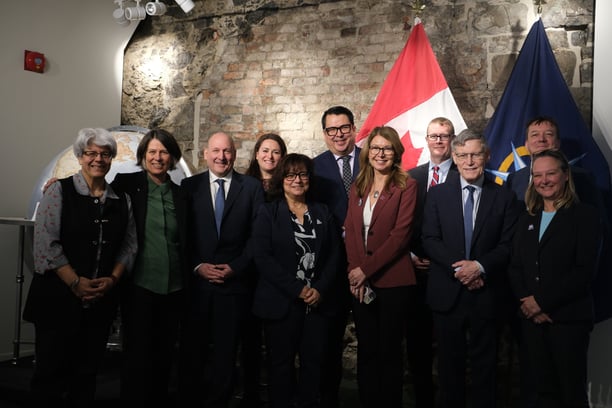
List of Roundtable Participants:
- Wade Grant, Parliamentary Secretary to the Minister of Environment and Climate Change Canada
- Terry Duguid, Member of Parliament for Winnipeg South
- Mark Fisher, President, Canada Water Agency
- Soula Chronopoulos, President, AquaAction
- Marie-Paule Jeansonne, Executive Director, de Gaspé Beaubien Foundation
- Meredith Brown, Director of Water and Land Relations, Canadian Geographic & Riverkeeper Emeritus, Ottawa Riverkeeper
- Jérôme Marty, Executive Director, International Association for Great Lakes Research
- Leanne Sexsmith, Director, Strategic Programs & Partnerships, Real Estate Foundation of BC and the BC Watershed Security Fund
- Dustin Garrick, Associate Professor and University Research Chair, University of Waterloo and consultant to the Gordon Foundation
- Dr. Alain Pietroniro, Professor, Schulich School of Engineering, University of Calgary
- Pauline Gerrard, Executive Director, IISD Experimental Lakes Area

.png?width=352&name=CIER%20Visual%20(1200%20x%20630%20px).png)