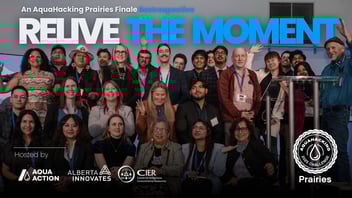
Excitement is building as the AquaHacking Prairies Grand Finale approaches. On February 5 at 2:00 p.m. (MT), five outstanding teams will take the stage in Calgary—and online—to present bold, practical solutions to some of the Prairies’ most pressing freshwater challenges.
This Finale is not just about what is being built, but who is building it. It celebrates students, young professionals, and emerging entrepreneurs who have stepped forward to turn their skills, creativity, and determination into meaningful action for our water.
Co-organized by AquaAction, Alberta Innovates, and CIER, the AquaHacking Prairies Challenge focuses on freshwater issues affecting the region’s vast and interconnected ecosystems. A core pillar of this fifteenth edition is the meaningful integration of Indigenous knowledge systems, alongside Western science, and collaboration with Indigenous-led organizations and community groups, ensuring that the solutions presented are not only innovative but also culturally grounded and community-driven.
After months of intensive collaboration, mentorship, and coaching, these finalist teams are ready to pitch their solutions to a panel of expert judges for a chance to win the grand prize of $20,000 in seed funding. This is not just the judges’ decision; the public will be able to vote live to award the $1,000 People’s Choice Award, celebrating the team and solution that connects most with the audience. In addition, CIER will present a $1,000 Two-Eyed Seeing Award, honouring a team that meaningfully integrated this approach in their solution.
Whether you join us in-person in Calgary or virtually via livestream, the Grand Finale is open to all. Wherever you are, you can be part of this critical moment for freshwater innovation.
This is a unique opportunity to discover not only cutting-edge water solutions, but also the inspiring individuals behind them. Watch their stories, hear their motivations, and see firsthand how these teams are building a water-secure future.
Small-scale agricultural water management
Purus Aqua - Runoff Filtration Device
Cleaner Water for Prairie Farms
Team members: Daniel Bielecki, Justyn Deenoo, Om Shah, Tejas Sarkar
Location: Edmonton, Manitoba, Canada
A passive filtration system designed to sit in prairie trenches and capture contaminants from runoff and snowmelt. This small-scale, low-maintenance solution supports sustainable agriculture by improving water quality and reducing pollution entering local waterways.
Tetra - Solar-Powered Water Purification
Clean Water, Off the Grid
Team members: Mubasshir Tahmid, Sabrina Rashid Sheonty, Anika Nawer
Location: British Columbia, Canada, and Edmonton, Manitoba, Canada
This decentralized solar-powered purification system provides safe drinking water for small clusters of 30–40 families. By producing and delivering purified jar water door-to-door, it offers an affordable, sustainable model for clean water access in remote or underserved communities.
Invasive species management
Consilience - Drift-Eye Swarm
Autonomous Detection of Invasive Species
Team members: César Pedrosa Soares, Sam Lucy Behle
Location: Saskatoon, Saskatchewan, Canada
Drift-Eye Swarm is a network of affordable, autonomous in-water devices that continuously monitor for invasive species. Compact and self-operating, these devices make large-scale aquatic surveillance accessible to local communities, helping prevent ecological and economic damage before it spreads.
ReverBio
Listening to the Water to Detect Invaders
Team members: Matthew Gaiser, Nicholas Lor
Location: Calgary, Alberta, Canada
ReverBio uses bioacoustic monitoring—underwater microphones combined with AI—to listen for the unique sound “fingerprints” of invasive species like Prussian Carp, goldfish, and zebra mussels. By detecting these invaders long before they are visible, ReverBio provides real-time alerts to communities, governments, and Indigenous stewards, making early intervention faster, cheaper, and more effective.
Small-scale & community decision-making tools for extreme water events
NAID Solutions (Network Aid & Incident Data)
Bridging the Information Divide & Data Fragmentation
Team members: Princess Cortes, Manju Thomas
Location: Winnipeg, Manitoba, Canada
This startup is creating a web-based application that transforms local knowledge and real-time community reports into verified, geolocated evidence on an interactive map, ensuring urgent environmental warnings are seen and acted upon. By combining live reporting, sentiment analysis, and an accountability ledger, it preserves traditional knowledge and connects people facing shared challenges with those who can help.
The innovation showcased by the finalist teams demonstrates the urgency and collective will to tackle critical water-related challenges. Their dedication and ingenuity underscore the scope of their commitment to a more regenerative and blue economy.
Join us on February 5th for a finale that promises to be memorable.