
Consumers today are increasingly alarmed by reports of PFAS (per- and polyfluoroalkyl substances), often referred to as “forever chemicals,” accumulating in drinking water systems. These chemicals, widely used in industrial and consumer products for their non-stick, stain-resistant, and water-repellent properties, have become pervasive in the environment.
From cookware and food packaging to firefighting foams and upholstery, PFAS have been embedded in daily life for decades. Today, unborn babies are now known to carry PFAS before birth, with multiple studies detecting these “forever chemicals” in umbilical cord blood. It’s no surprise, then, that the vast majority of people have PFAS in their bloodstreams.

Now, as science and regulators work to define what concentration levels are safe, municipalities and water treatment operators across North America are rapidly trying to find solutions to keeping their waters clean for drinking, and safe for the environment.
The issue hits close to home for those homeowners that rely on well water who discover that decades of industrial leaching near their homes have left the groundwater sources contaminated, requiring expensive filtration systems to ensure water is safe to drink.
From rapid detection at the source to advanced filtration and nature-based remediation, AquaAction innovators are developing practical solutions to tackle this issue.
Nature-Based Solutions: Myconaut
For Ryan Iacovacci, the answer lies in biology.
His company, Myconaut, mushroomed out of the 2024 AquaHacking Great Lakes Challenge.
They use fungal cultures for bioremediation, harnessing the natural properties of mushrooms to help break down PFAS in contaminated soil.

As Ryan like to say, calling them “forever chemicals” isn’t altogether true. “a more accurate description is that they are extremely difficult to break down due to the strength of the carbon-fluorine bond, though not impossible.”
Ryan sees health risks posed by PFAS, as a primary reason to act, saying “they disrupt hormones, damage immune systems, and are increasingly associated with cancer and chronic disease.”
With their novel approach to fungal PFAS bioremediation, Myconaut attracted some prestigious recognition last year, being accepted into the NVIDIA Inception Accelerator Program and winning National Science Foundation Small Business Innovation Research grant.
For Ryan, who farmed growing up, Myconaut allows him to champion an approach that uses “biology rather than bulldozers to restore soils and protect water.” It delivers practical, scalable solutions clean up contamination and keep land productive instead of written off. “If we fail to work with farmers to restore the land base, the consequences will ripple through local tax rolls and bankrupt municipalities nationwide.”
Rapid Detection: Wave Lumina
Other AquaAction entrepreneurs are also tackling PFAS from different angles.
Wave Lumina, who also emerged from the AquaHacking Great Lakes 2024 Challenge, has developed a portable field-testing platform for rapid, on-site PFAS screening. The system is designed to provide fast, actionable screening data to inform laboratory analysis and remediation workflows.
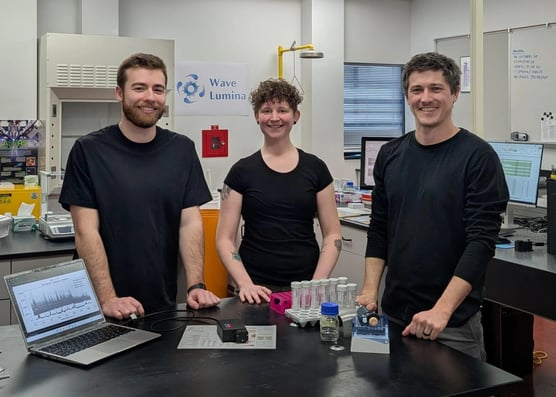
In 2025, Wave Lumina also received a National Science Foundation Small Business Innovation Research (SBIR) award, and founder Vernon LaLone was selected as an Activate Fellow, supporting the continued development and commercialization of its technology.
The company collaborates with engineering firms, consultants, and site operators to support data-driven PFAS management decisions. Its multidisciplinary team, including research scientist Stephanie Baklarz and engineer Nathan Tafelsky, is currently preparing for multiple field pilot deployments in 2026.
Advanced Filtration: Ecofilter Tek
Ecofilter Tek, part of the second edition of AquaEntrepreneur, is advancing a breakthrough filtration solution using novel regenerable ion exchange resins called AmphoRes.
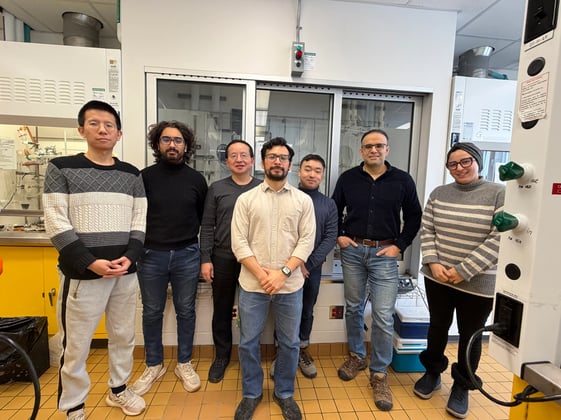
Their technology works like a magnet for PFAS: as contaminated water passes through, the resin attracts and holds PFAS molecules. Special to their product, the filter can be regenerated and reused thanks to an innovative technology used in the fabrication of AmphoRes and without any harsh and toxic chemicals. So, the filtration system not only lasts longer and is more environmentally friendly than many traditional filtration approaches, but it also solves the problem of forever chemicals by concentrating them to a point where they can be destroyed altogether.
PFAS Destruction: E2METRIX™
For the Sherbrooke-based company E2METRIX™, the goal isn’t just to remove PFAS, it’s to destroy them.
Their process starts with OLift®, a vertical column where streams of tiny bubbles move through contaminated water. PFAS cling to the bubbles and rise to the surface, forming a concentrated foam. Ozone is added to make this step more effective.
That foam is then treated in the Obreak® reactor, where an electrical current breaks the molecules apart so they are no longer harmful.

The result is up to 99.9% removal of regulated PFAS.
And the system can be brought directly to where it’s needed. E2METRIX’s mobile units can be installed on site, making it possible to treat PFAS without building new infrastructure.
Learn more about their solution here!
Innovation as a Path Forward
The PFAS crisis presents both an environmental and infrastructure challenge. While regulators work to catch up with decades of scientific research, it’s communities and the families who live there are turning to innovation to stay ahead.
Through rapid detection technologies, improved filtration, and nature-based bioremediation, AquaAction is helping to cultivate an ecosystem of innovators tackling the issue from source to sink.
As these solutions continue to evolve, they offer hope that the legacy of “forever chemicals” may not, in fact, be forever.